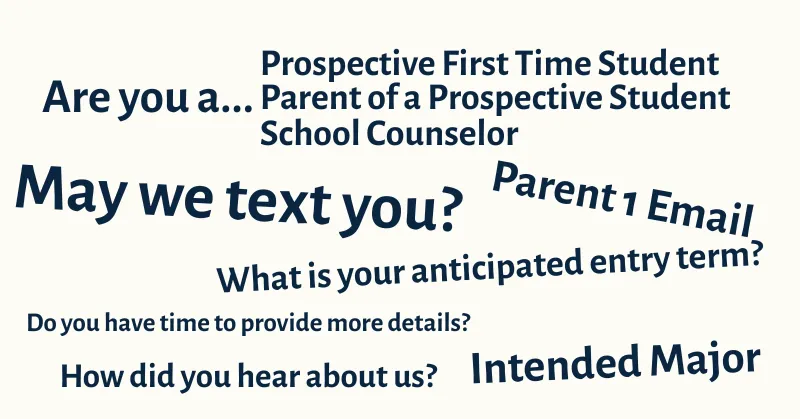
2025 Inquiry Form Benchmarks: An In-Depth Look at 750+ Slate Schools
After a prospective student has clicked through to your inquiry form, what can they expect to find? How many questions will they have to answer in order to join your mailing list? What kinds of information will they be prompted to provide?
As part of our analysis of more than 750 Slate inquiry forms in 2025, we looked at how different institution types approached the length and structure of their inquiry forms, including, in the case of certain fields, how the fields are mapped.
To help understand variations across institution types, we've broken down institutions based on Carnegie Classification of Institutions of Higher Education® and by IPEDS data on selectivity and institution size.
Source: Carnegie Classification of Institutions of Higher Education®, American Council on Education. carnegieclassifications.acenet.edu
In This Article
Form Length & Core Questions
1. Form Length
Across all Slate institutions that had a single-page form, the average inquiry form contained 16.3 questions. This count includes questions that appeared based on conditional logic for prospective first-year students who were opting in to provide core contact information for themselves and a parent. If a form appeared to offer additional sections for students wishing to provide more detailed information about athletics, extracurriculars, or specialized pre-professional interests, those were excluded from the count.
When forms are grouped into five buckets based on length, we found that Baccalaureate Colleges (Arts & Sciences Focus) were more likely than other types to have forms at the two extremes, with either fewer than 10 questions or more than 25 questions:
When grouping by size and selectivity, it becomes clearer that the most selective institutions (particularly the smallest) are the likeliest to have longer forms:
2. Academic & Timing Information
Asking for a prospective student's academic and timing interests are overwhelmingly common practices. 98% of forms ask for an intended entry term, and 87% ask for a program of interest.
Audience & Communication
3. Identifying the User: Parent or Student?
One challenge with inquiry forms is that the person filling out the form might not be the student: parents, counselors, or alumni might sign up or refer a student; if the wording of questions isn't clear, this can sometimes lead to inquiry records being created in the name of those individuals, rather than in the name of the student.
Some schools attempt to solve for this challenge by asking an identifying question, usually at the top of the form, and then either conditionally displaying different sets of questions or routing the parent or other individual to a dedicated form. We wanted to measure how common this practice had become as of 2025, and whether it was more common at certain types of institutions than others.
4. Parent & Family Information
As schools seek to engage parents directly, collecting parent information at the point of inquiry can help create opportunities for engagement earlier in the recruitment process.
For many institutions that implemented Slate pre-COVID, it was common to create custom person-scoped fields to store parent contact information, with the standard relation table only being mapped at point of application. This approach was often recommended in order to help avoid data issues (inconsistent email addresses or spellings of parent names) from lower quality sources like inquiry forms, compared to the application. Discrepancies can result in duplicate relation records if relationship type is not collected, for example, or if first name and last name are inconsistent (see this KB article)
While many schools do still use these custom fields, the majority of those that collect parent information on the inquiry form do so by mapping directly to the relation table. With parent information stored using relation records, it becomes possible to build recipient list queries using the relation base for parent communications, following the Technolutions best practice for Messaging Relationship Records.
5. SMS & Texting Consent
Engaging prospective students via text is a common practice, but we observed that a significant proportion of schools rely on passive disclaimer language rather than standalone fields that capture explicit opt-in consent.
Between regulations and carrier A2P compliance standards requiring affirmative opt-ins, we recommend that schools consult with their general counsel's office to ensure their practices are compliant. Technolutions includes suggested "Further reading about A2P 10DLC" in their Compliance Dashboard Knowledge Base article.
Notably, we also observed a trend of this disclaimer language being expanded to include consent for AI-generated calls or messages, adding another layer for review.
Marketing & User Experience
Finally, we analyzed questions related to marketing intelligence and user experience design patterns.
6. Marketing Attribution: "How Did You Hear About Us?"
If stakeholders are pushing for greater clarity around marketing attribution and the source of leads, adding a question directly to the inquiry form can be tempting. However, this is relatively uncommon across school types, and adds to form length. If gathering this information at point of inquiry is not affecting your follow up outreach, it may be more beneficial to save the collection of this data point for later in the process.
7. Including Optional Steps: "Have Time for More?"
One solution to the problem of overly long forms is to give students the choice: you can either submit right away, providing only the essential data points, or, if you have a few moments, provide additional details.
As with collecting marketing attribution data, it's important to make sure the data collected in these optional sections is useful and helps inform the relationship you're developing, rather than simply collecting data for the sake of easier reporting. It's worth asking whether these additional data points could be collected instead as part of a follow-up, so that the focus remains on the student's needs.
Conclusion: Revisiting Form Practices to Reduce Friction for Prospective Students
While every institution takes its own approach to collecting inquiry data, it's important to understand the evolving practices of your peer institutions and to regularly review how your own approach compares.
A great inquiry form experience remains centered on the student: asking only what's needed to spark further discussion and build a relationship. Reducing the friction students experience in filling out your inquiry forms is our goal with this analysis, whether that involves cutting a few fields, changing how you're collecting a key data point, or giving users an experience that adapts to their preferences.
As you discuss your form questions with your team, we hope this analysis helps guide those conversations toward a student experience that is intentional and focused on building great relationships.
Looking for direction around your Slate data collection and reporting? Reach out to info@predicatehighered.com to discuss how we can help.